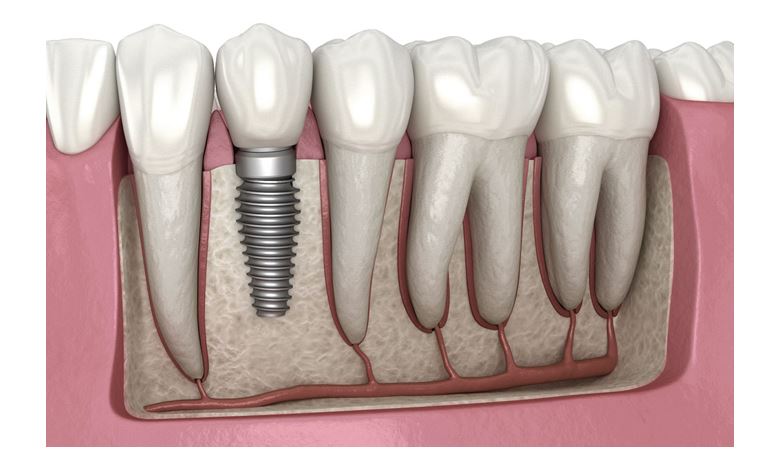
- Dental Implants differs from other forms of teeth replacement in that they are anchored in and supported by the jawbone. They are the artificial substitute for the root of the teeth and function in almost the same way and preserves the bone height and width.
- Dental Implants can be used for replacement of single missing teeth or multiple missing teeth serving as anchors for fixed prosthesis and / or removable dentures.
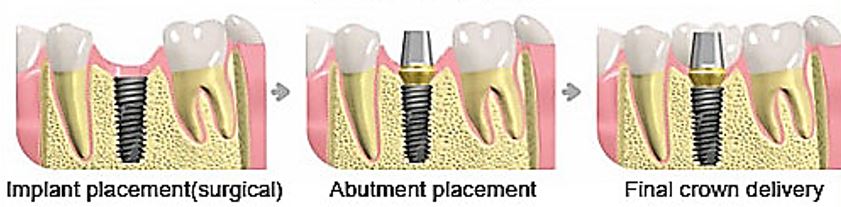
- Dental Implants are made of biocompatible Titanium alloy and they are surgically placed at planned positions inside the jaw bone based on findings from CT or CBCT scans and clinical evaluation.
- The surgical phase is followed by a prosthetic phase after a few days or months where the artificial teeth replacements are fabricated in the lab and fixed to the dental implants. This is followed by a life long maintenance phase.
Implant Procedure
Additional procedures which might be required
- Extraction (removal) of few teeth – those teeth which cannot be saved by RCT or which are fractured or those with advanced bone loss ; simplifies the treatment plan.
- Bone grafting with GTR membrane placement – to augment the deficient bone in width and height and covered with collagen membrane to assist in bone regeneration.
- Sinus lifting – to surgically elevate the maxillary sinus floor using bone grafts which has expanded into the bone in the upper posterior teeth region to allow the placement of longer implants.
- Nerve repositioning– surgically reposition the nerve structures in the lower jaw to allow for the placement of longer implants.
- Radiographic stent fabrication – acts as a guide during the CT or CBCT scans
- Surgical stent fabrication – acts as a guide for Stage 1 and Stage 2 implant surgery.
Risks
Implant placement, being a minor oral surgical procedure, the risks involved are the same as those in other minor oral surgeries such as extraction and impaction surgery. However a few risks are specific to dental implant procedures and they are outlined as follows. The risks are broadly classified based on stage of the treatment – surgical and prosthetic.
Surgical Risks
- Post surgical infection, bleeding, swelling, pain, facial discoloration, sinus or nasal perforation
- TMJ injuries, muscle spasms, bone fractures, poor wound healing, unsuccessful integration of implant to the bone.
- Numbness or altered sensation (paraesthesia) of the lips, chin, cheeks, tongue which is usually temporary but occasionally become permanent.
Prosthetic Risks
- Fracture of implant components during either the surgical, prosthetic phase or maintenance phases
- Material failure of the prosthesis due to wear and / or fatigue
- Change in occlusion (the way the upper and lower teeth bites) due to the prosthesis
- Improper fitting prosthesis due to errors in impressions or processing
Alternative treatment options
- Tooth supported fixed prosthesis – the teeth adjacent to the missing teeth serves as support for the prosthesis; risk of decay on the adjacent teeth and failure of the prosthesis
- Removable Partial / Complete ( tooth or tissue supported ) Dentures – the underlying jaw bone and the gums and few selected natural teeth or root canal treated teeth provide support for the prosthesis; bone loss keeps progressing and the prosthesis has be remade every 3 years or lesser for better fit.
- No treatment – the teeth adjacent and opposing to the missing teeth keeps migrating leading to collapse in occlusion (bite) and loss or reduction of chewing efficiency and the accompanying nutritional deficiencies and reduction in the quality of life
Unanticipated conditions
During the course of the treatment, unanticipated clinical conditions might arise requiring the change or modification of treatment plan. This needs to be managed based on the clinical judgement of the dentist in consultation with the patient.
No guarantee
Dentistry is not an exact science. Although implants have a high success rate (almost 96 %) when compared other forms of treatment, the response to treatment for each patient is unique and depends upon a lot of factors. There is always a risk of failure, relapse, need for more treatment and worsening of the present condition despite careful treatment and thus guarantees of success cannot be made and thus re-treatment and / or alternative treatments might be needed.